


Eli Degibri’s tenth album as a leader. Out November 3, 2026.
My One and Only Love
“Israel is my one and only love.”
October 20
Single: My One and Only Love
October 27
Single: Is There a Doctor in the House
November 3, 2026
Album: My One and Only Love

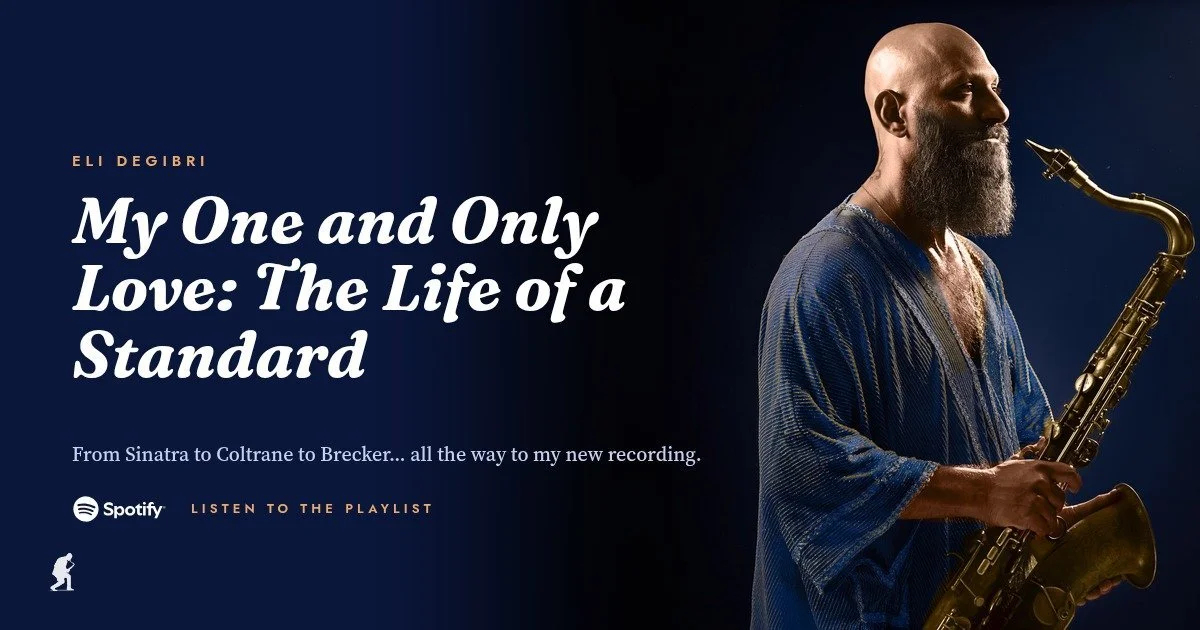
The story of the song
My One and Only Love: The Life of a Standard
Follow “My One and Only Love” from Sinatra’s 1953 single to Coltrane, Rollins and Brecker, all the way to Eli Degibri’s new 2026 recording.
My One and Only Love
Tracks
01 Is There A Doctor In The House 5:33
02 Requiem to Henri 7:22
03 My One and Only Love 9:01
04 Love For Sale 4:51
05 The Good Fairy Rachel 4:20
06 Momento Fugaz 3:50
07 Oreo The Dog 3:59
08 Lydian Smile 4:30
09 God Bless Little Dorian 6:07
Featuring
Eli Degibri Saxophones
Tom Oren Piano
Alon Near Bass
Eviatar Slivnik Drums
All compositions by Eli Degibri except My One and Only Love (Guy Wood / Robert Mellin) and Love For Sale (Cole Porter).
Mixed and mastered by Adrian von Ripka, AVR Studio

My One and Only Love
Tel Aviv-based saxophone master Eli Degibri proudly announces the November 3, 2026 release of his tenth leader album, My One and Only Love, an interactive, soulful performance by his brilliant quartet of Israeli rising stars. Recorded when the quartet was booked at Manhattan’s Blue Note in January 2023, the seven originals and two arrangements portray, in Degibri’s words, “the story of war that made me even more proud of this place that has done so much for me. Israel is my one and only love.”
Degibri conveys the volcanic emotions embedded in the notes and tones with a string of rhythmically fluid, melodic declamations, rendered with a warm, flexible sound and what pianist Aaron Goldberg, a long-time colleague, once described as a “refined, creative jazz sensibility” and a propensity to apply an aesthetic attitude that is “less about playing a lot of stuff over the changes than trying to tell a story every time he puts a horn in his mouth.” Degibri’s ensemble teacher at Berklee School of Music acknowledged that attribute thirty years ago, stating “You play old in a new way,” after hearing him solo on Wayne Shorter’s “Yes and No”. “That’s been my motto ever since,” Degibri says.
Consider how Degibri takes ownership of the title track, an iconic ballad “that every musician has played a thousand times,” among them tenor saxophone gods Michael Brecker (“my hero”), John Coltrane, and Sonny Rollins, and mixes Western and Middle Eastern elements to transform it into “an homage to this place that basically made me what I am. You can hear the love and the affection, the sadness and also the aggression, and the connection between East and West, between Jews and Arabs. I grew up in Jaffa, where Arabs, Muslims and Christians grew up together with Jews in school. We all were mixed. I am all these elements, and I am proud to be all of that.”
Throughout the metrically modulating, nine-minute tour de force, Degibri and 2018 Herbie Hancock Competition-winner pianist Tom Oren, bassist Alon Near, and force-of-nature drummer Eviatar Slivnik establish the ambiance of risk-taking, dramatic tension, close listening and virtuosic chops that characterizes the entire recital. Their high level of interplay, the product of seven years (at the time) as a working band, prompted the leader to remark that he sees My One and Only Love as a continuation of his superb 2010 album Israeli Song, on which he functioned as a co-equal collaborator with Brad Mehldau, Ron Carter and Al Foster, allowing each master to be team players while fully expressing their individuality.
“The logic was that I’m an Israeli who came to the U.S. to learn about jazz and to play my compositions with my idols and legends,” Degibri says. “The dream has come to life. I sent them the music, they learned it, and came to the studio and played it. But I’m still an Israeli. It’s the story of Eli, or Isra-eli Song.”
“Here I’m telling a similar story from a more mature point of view, as an established musician back in the place that raised me, and I’m doing it with Israeli musicians who also have this dream, who probably heard Israeli Song when they were kids, and maybe I can make their dream come true.”
After a year at Berklee, Degibri left for the Thelonious Monk Institute, then based in Boston and directed by Ron Carter. A year later, Carter recommended the 19-year-old to Herbie Hancock, who showcased Degibri’s muscular sound, provocative approach, and refined, creative jazz sensibility on stages around the world during a 30-month stint performing repertoire from Hancock’s Grammy-winning Gershwin’s World album. Based in New York from 2002 to 2013, Degibri refined his maturity and taste as a sideman in drum grandmaster Foster’s quartet, and formed his own quintet with Kurt Rosenwinkel, Goldberg, Street and Ballard for which he began to write music marked, as Goldberg wrote at the time, by “extremely singable songwriting in a way that’s magical to me: Eli composes melodies as well as the best pop composers.”
That melodic mojo applies to the album-opener, “Is There A Doctor In The House,” on which Slivnik’s percolating 15/4 propels Degibri into a five-minute solo that somehow manages to be ascendant and measured. On “Requiem To Henri,” dedicated to his recently deceased father, Degibri’s improvisation incorporates sounds and influences inculcated during his years-long study of classical piano, while Oren brings forth his prodigious technique on a brief solo.
Degibri’s full-bodied improvisation on Cole Porter’s “Love For Sale” proceeds to Slivnik’s crisp, precise samba beat, which he absorbed over the years through such Brazil-influenced Israeli composers as Yoni Rechter and Matti Caspi. After several rollicking choruses by Oren, Degibri and Slivnik build the intensity on a lengthy concluding vamp.
After revisiting “Momento Fugaz” (it debuted on Degibri’s 5-star DownBeat album Cliff Hangin’), highlighted by Oren’s scintillating chromatic solo, Degibri offers “Oreo The Dog,” a jaunty, playful medium blues named for a recent addition to his family. “Many dogs were abandoned when the war started,” Degibri says. “Adopting him was a beautiful thing; he brings us and the babies so much love.”
The album concludes with “God Bless Little Dorian,” named for his first-born son. The opening bass motif echoes the harmonies from Sonny Rollins’ “amazing” version of “God Bless the Child” with Jim Hall on guitar, on The Bridge. Degibri and Alon Near play with equivalent sensitivity and reverence.
“Covid came right after I recorded my last album,” Degibri says, referring to Henri and Rachel, his heartfelt paean to his elderly, now-deceased parents and his bride-to-be, now the mother of his children. “I had to cancel several tours and other commitments, and I became depressed and angry. But when I was ready to pick up the pieces, I had an epiphany. I realized that I don’t want the life of touring. Since then I’ve hardly traveled. I wrote all but one of the compositions on My One And Only Love before Covid, and doing the record has allowed me to move on and start writing again. Now, my life is a great mix of doing the quartet and big band, some teaching at the Academy of Music and Dance in Jerusalem, singing in public, interacting with great musicians, and mostly being a family man.”
- Ted Panken
“The ambiance of risk-taking, dramatic tension, close listening and virtuosic chops that characterizes the entire recital.”
- Ted Panken